
About Us
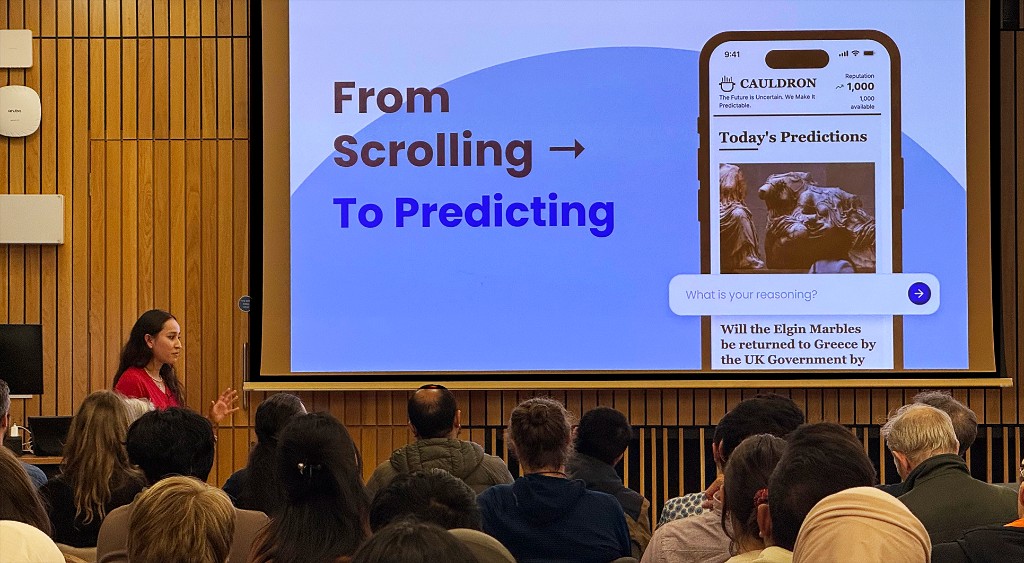
Cauldron is a London-based startup reimagining how we engage with current affairs in an age of information overload and AI-generated content. Instead of passively consuming endless headlines, you make predictions about real-world events. What might happen, when, and what counts as an outcome.
A Simple Way to Stay Informed
Overwhelmed by news or avoid it entirely? You're not alone. Much of today's news is encountered through feeds, recommendations, and summaries. Information arrives quickly, but often in fragments and without clear endpoints. It can be difficult to tell what matters, how pieces fit together, or when a story is actually resolved.
Cauldron offers an alternative way to engage. Instead of presenting news as a continuous stream, current affairs are framed as clear questions about the future, each with an observable outcome. This makes it possible to slow down, focus on a few topics at a time, and form a view (even if it's provisional) without reacting to every update in isolation.
How It Works
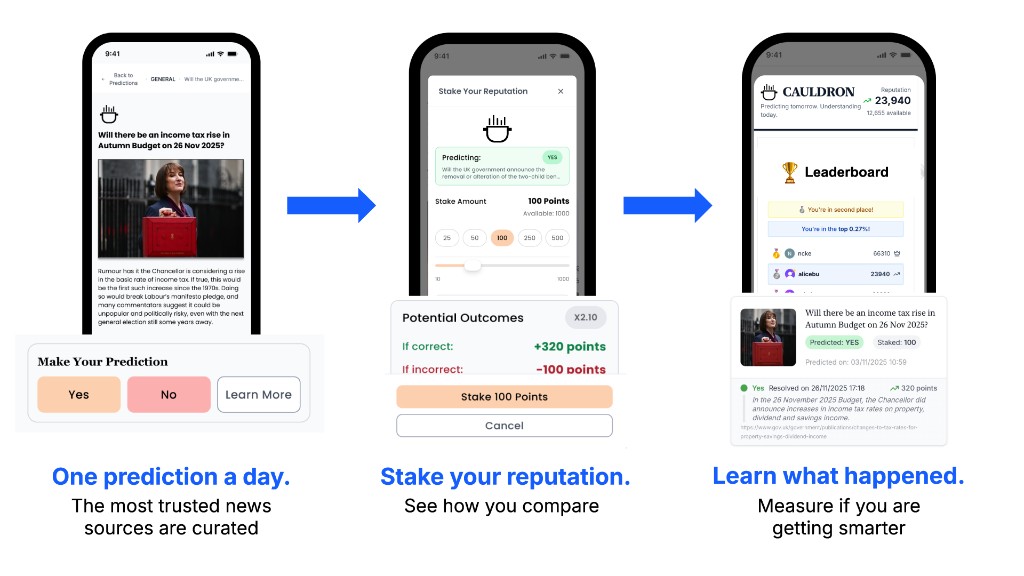
Engagement on Cauldron follows a simple loop:
- 1.Pick a question about an ongoing event
- 2.Make a prediction, even if it's just a guess
- 3.Use the Learn More feature to get more context from relevant sources
- 4.Update your view as new information appears
- 5.See what actually happened
- 6.Gain points on the Cauldron leaderboard and build your track record
Context Without Overload
Each question comes with a small set of background context cards, chosen for relevance rather than completeness. The goal is to provide enough context to think clearly, without encouraging endless consumption or information overload.
You choose what feels worth your attention. There's no expectation to keep up with everything.
Why Prediction
Prediction isn't a specialised skill reserved for experts. People constantly form expectations about what is likely to happen next, often implicitly, when interpreting events, assessing risks, or deciding where to focus their attention. Cauldron makes this everyday process explicit so it can be examined, improved, and refined.
Making a prediction requires taking a position, even provisionally. It requires deciding which claims are credible, where uncertainty remains, and what would count as evidence. This constraint helps surface assumptions and focus attention on what is genuinely relevant. Engagement shifts from reaction to evaluation, and thinking becomes more deliberate and less driven by novelty or alarm.
What People Are Saying
Cauldron is becoming a daily habit for its users.
Learning Over Time
There's no rush here. You can arrive with uncertainty, partial understanding, or simple curiosity. Cauldron isn't designed for speed, volume, or constant engagement with news. It's built to support thoughtful attention and understanding over time.
As new information appears, predictions can be updated. Changing one's mind is expected and encouraged. Cauldron follows each question through to its outcome, so it's possible to look back at what was expected and what actually happened.
That sense of closure helps turn attention into learning, rather than something that simply fades away. The goal isn't to predict the future, but to feel more oriented in the present and to learn as events unfold.